Lift Table Buyer's Guide |
Lift tables are used to raise and position materials for a worker in such a way as to reduce potential injuries in a wide array of industries. Lift tables are designed to impose proper ergonomic principles into common work functions, and thus the selection process of this equipment is very important to achieve the maximum benefit of their application.
By following the few basic steps outlined below, proper equipment selection can be easy to understand and achieve
Step 1: Identify the characteristics of the materials being handled
How heavy is the entire load that is in need of being positioned?
Models commonly support loads ranging from 1,000-6,000 lbs in 500 lb increments.
What are the dimensions of the entire load?
You will want to select a lift table top size that supports the majority of the load, while being careful to not get a table to small for stability sake, or too large whereby the top may overhang the load to such a degree as to force workers to have reach.
How will the load be placed on and off the equipment being selected?
If by forklift or conveyor a standard lift table will be fine. However, if a pallet truck or other floor level loading is required, a ground entry table, or pit-mounted table must be used which will increase cost significantly due to design characteristics and OSHA compliance.
If the load consists of individual items what is their weight and size?
The size of individual items is important in targeting how high the lift table must lift to provide proper ergonomic positioning. Fundamentally, you will want the highest placement or the lowest placement of an individual product to be as close to waist level as possible. The typical range for lift tables are 24", 36" and 48" models with a lowered height of 6-8", this provides a range of table heights from 6" to 54" to select from. In addition the heavier the individual item is the more important it is that the item can be placed exactly at waist level and within short reach of the operator to reduce strain.
Step 2: Identify what exposures to workplace injuries exist in the work area
How often will the operator be required to lift a load?
The more items an operator handles the more likely RMI (repetitive motion injuries) are to occur. Thus the more repetitions of a job task the more exacting you will want to be with ergonomically correct placement. Electro-hydraulic lift tables typically provide the most exact product placement versus weight sensitive devices or pneumatic models, which often neglect variability in operator height or item dimensions, variable weights and move inconsistently making it hard for the operator to place the load correctly.
How far will an operator be required to reach to retrieve or place a load?
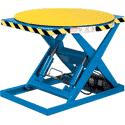
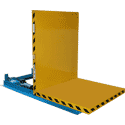
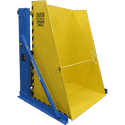
Reaching is considered by many experts to be as bad or worse than lifting as it pertains to workplace injuries. The smaller individual items are the more reaching that is typically involved. Weight and distance are large concerns in this area, and many design variations of lift tables are available to reduce such exposures. Load rotation is one of the most effective ways to address reaching exposures, or if the load is conducive to such handling tilting tables can also provide operators better access for item retrieval or placement.
How far will an operator be required to carry a load?
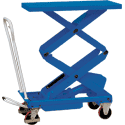
Keeping carrying distances short is also vital in eliminating injury exposures. To this end proper placement of a lift table is very important, and most lift tables can be outfitted with mobility options, such as casters, fork pockets or dolly's to help shorten significant transition distances.
Step 3: Identify the characteristics of where the work will be done
Are their any special environmental variables that may effect the equipment?
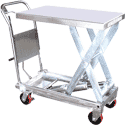
Many lift tables can be made with stainless steel, special bearings, and with power supply's to meet a variety of industry specific environmental compliance standards.
What physical restrictions may hinder proper access to the equipment?
Typically a lift table will take up only slightly more space than the load it is handling. However, certain design concepts may take significantly more floor space, which without proper consideration can lead to additional hazards to the operator.
Where can operator controls be placed in the work area?
Pedestal mounted controls, foot controls, and magnetic backed control boxes are all useful options to consider when selecting a lift table. Primarily you will want equipment controls to be in a location that the operator can optimize for ergonomic benefit, and additionally negate any potential tripping hazard.
What power supply is available in the work area?
Electro-hydraulic lift tables can be specified to run on single-phase 115 volt, 230 volt, or three-phase voltages of 230 or 460. The initial stroke of lift tables often creates a high amp draw as the equipment gains inertia, especially on higher capacity tables. Single-phase models thus may require dedicated 20-30 amp circuits, while three-phase units will operate quite efficiently and are recommended in high usage applications.
Step 4: How to select a lift table that will perform
Can the unit be tailored to meet my specific application?
Over the past decade many manufacturers have moved toward mass marketing lift tables in national catalogs and over the internet. While this has created many benefits, much of the necessary tailoring required to meet the ergonomic criteria of a specific application has been lost in the pursuit of more streamlined manufacturing. If an application dictates specifications outside standard configurations, seek out a manufacturer that will supply a lift table to meet your specific needs. Only then will you truly reduce the exposure of potential injuries, which is time and money well spent.
How is the basic table constructed?
If you have a light duty application or low usage, most tables will fit the bill quite nicely. However, if you require a more industrial grade table look for hallmarks such as fabricated scissors arms (rather than tubular steel), all welded construction, and that the table meets or exceeds the industries quality standard ANSI MH 29.1 enacted in 1994.
What components are preferable to other components?
High quality cam rollers, pivot pins and bearings can make or break a lift table. When selecting a lift table give preference and scrutiny to these components as well as the duty cycle of the motor that powers the table. The longer the duty cycle the better as far as motors go, and staying with a quality manufacturer such as Baldor or Leeson is always preferred rather than a imported or generic motor due to the rigorous demands tables often put on hydraulic pump motors throughout a workday.
What components assist in extending the service life of a lift table?
Maintenance is the key here just like with any equipment. While some tables feature no maintenance capabilities and just wear out, some do offer maintenance capabilities that can greatly extend service life. Grease fittings on pivot points and cam rollers are crucial in extending the service life of a lift table. In addition, having motors and controls easily accessible and separated can be an important variable to overlook. Some manufacturers have made modular power units that are not directly serviceable which is also a significant concern in regards to service life to consider.